CANADA BUILT ITS FORESTRY INDUSTRY FOR ONE CUSTOMER.
HERE’S HOW TO CHANGE THAT.
– How biomanufacturing and investment-ready BDO Zones can remake Canada’s forest economy –

Canada’s forest industry is being dismantled in plain sight.
Over the past year, trade uncertainty and U.S. tariffs have erased thousands of forestry jobs and billions of dollars in economic value. Mills have closed. Communities that depend on forestry have been destabilized. Investment has stalled.
This is not a cyclical downturn. It is a structural failure.
For decades, Canada built its forest economy around a single export market and a narrow set of commodity products. That strategy has now been exposed as dangerously fragile. Our closest trading partner has proven unreliable, and the cost of over‑dependence is being paid by rural workers and regions across the country.
Canada does not have a forestry problem. We have a market diversification problem.
Ironically, today’s global uncertainty has created a once-in-a-generation opportunity. Policy volatility in the U.S. has global manufacturers reassessing where to invest. Capital is mobile, and companies across the biofuels, biopower, renewable chemicals, and advanced materials sectors are actively looking for stable jurisdictions in which to build new production facilities. Canada can and should be at the top of that list—but we need to build the foundational infrastructure to make this happen.
Other countries have already shown what investing in enabling infrastructure looks like. Finland is pursuing a national strategy to double the value of its forest sector without harvesting more wood by shifting away from commodity exports and toward advanced wood products, renewable chemicals, and bio-based fuels. Companies such as Metsä Group, Stora Enso, UPM, and Neste transformed legacy pulp and paper assets into globally competitive platforms for renewable diesel, sustainable aviation fuel, biomaterials, and engineered wood. Finland built the infrastructure required to catalyze rapid development of new markets—and it’s working.
Canada has the same raw material advantage, industrial know-how, and access to deep capital markets. What it lacks is the foundational infrastructure required to deliver the market diversification our forest economy now desperately needs.
One of the most overlooked pieces of industrial infrastructure is investment-grade data and intelligence. Nationally consistent, credible, standardized datasets on forest biomass resource availability, infrastructure capacity, workforce readiness, and permitting pathways give developers and investors around the world the clarity to quickly identify the optimal locations across the country to build new biomanufacturing plants at lower risk—especially former mill sites. When that clarity exists, biomanufacturing projects move faster—from site selection to financing to construction—allowing Canada to catalyze and accelerate the development of new plants that turn wood fibre into higher-value products that can be used domestically and exported globally.
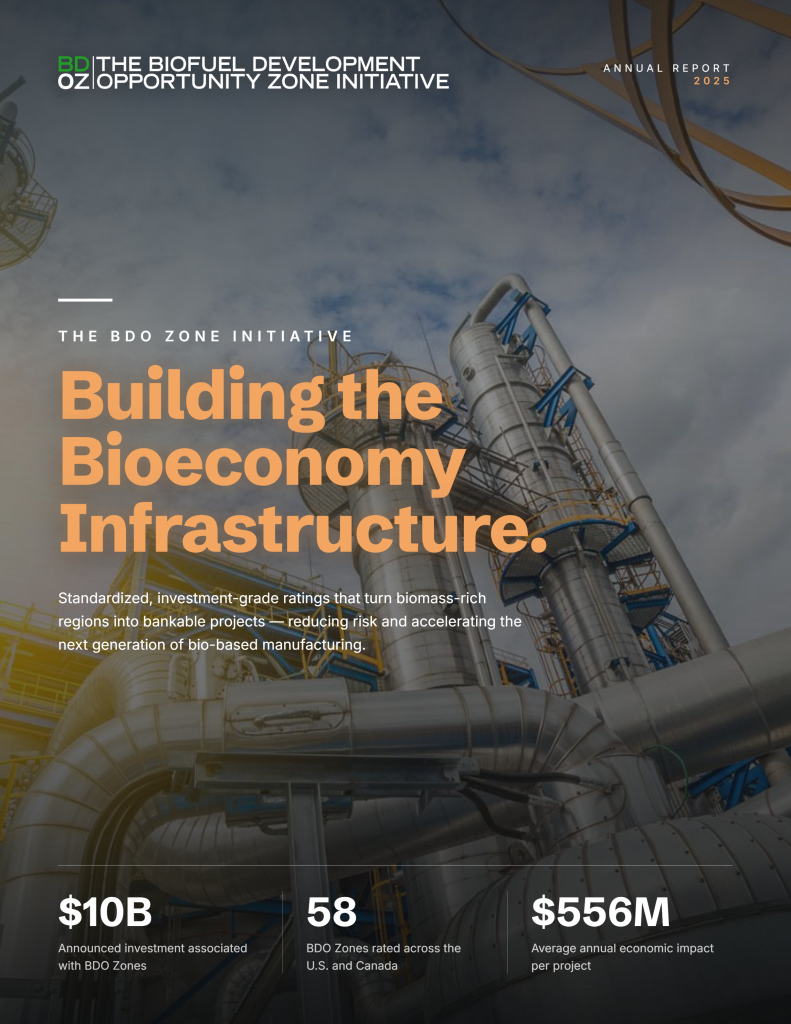
Fortunately, this kind of investment-grade intelligence is already being produced through CSA standards-based designations called Biofuel Development Opportunity (BDO) Zones. BDO Zones function as market-facing infrastructure—translating data on feedstock, sites, infrastructure, and permitting into investment signals that accelerate project development. This approach has been associated with billions of dollars in announced new biomanufacturing projects in North America, such as the recent $845M plant announcement by Provectus Biofuels in the Vegreville, Alberta, BDO Zone.
The benefits are tangible. A single large biofuels facility can generate hundreds to thousands of construction and permanent operating jobs, often in regions hit hardest by pulp mill closures. Independent research examining biomanufacturing projects announced in BDO Zones shows these facilities can generate hundreds of millions of dollars annually in total economic impact across rural economies.
Putting project-ready BDO Zone data in the hands of Canada’s global investment teams would markedly improve their ability to drive new investment into the country.
Canada already has a strong, capable global trade and investment network through Invest in Canada and the Trade Commissioner Service. What is missing is a standardized, site-level intelligence layer that allows these teams to respond quickly and confidently when global firms explore biomanufacturing investments. BDO Zone data can provide that foundation—acting as a force multiplier—enabling them to do their work more effectively and attracting billions of dollars in new plants producing biofuels, renewable chemicals, and biomaterials from Canadian wood.
The federal government’s new Canadian Forest Sector Transformation Task Force opens a critical window to address structural weaknesses in Canada’s forest economy. By enabling market diversification for forest products and reducing dependence on the United States, BDO Zones merit consideration as part of this work.
Canada did not choose this crisis. But it can choose how it responds.
We can continue reacting to closures, trade shocks, and lost investment — or we can build the data and execution infrastructure that allows new markets to form, new plants to be built, and new value to be captured at home. That choice will determine whether this moment is remembered as another missed opportunity, or as the turning point for Canada’s forest economy.
Originally published in iPolitics on January 29, 2026.
Jordan Solomon is President and CEO of Ecostrat, Chairman of the Biofuel Development Opportunity (BDO) Zone Initiative and a global authority on forest and biomass investment strategy. He led the development of the Canadian Standards Association’s Biomass Supply Chain Risk (BSCR) Standards and the BDO Zone standards, which are now used to attract and de‑risk billions of dollars in biomanufacturing investment across North America.
Fred Ghatala is President of Advanced Biofuels Canada, the national industry association that played a central role in the development and implementation of Canada’s Clean Fuel Regulations. ABFC has been directly involved in shaping the policy frameworks that enabled commercial-scale production and use of ethanol, biodiesel, renewable diesel, and sustainable aviation fuel across the country.

About The BDO Zone Initiative
The Biofuel Development Opportunity (BDO) Zone Initiative certifies ‘regional readiness’ for bio-manufacturing, creates global connections and ignites an influx of new energy opportunities for farmers, economic developers, and rural businesses. A BDO Zone rating is an internationally recognized, standards-based technical risk assessment of a region’s feedstock, supply chain, and infrastructure risk with respect to the development potential for new biofuel plants. BDO Zone ratings are site location bullseyes for bio-project development. Investment grade ratings are force-multipliers for attracting new manufacturing plants to the areas where they are most likely to succeed, drive investment and create jobs.
For more information on the BDO Zone Initiative, contact info@bdozone.org. To view all BDO Zone ratings, visit www.bdozone.org. Check out the BDO Zone LinkedIn page for news and updates.
Ecostrat is the North American leader in biomass due diligence for biofuels, renewable chemicals, biogas, and bio-product project development and finance. Jordan Solomon (jordan.solomon@ecostrat.com) is Chairman of the BDO Zone Initiative and President of Ecostrat (www.ecostrat.com).
About Advanced Biofuels Canada
Advanced Biofuels Canada/ Biocarburants avancés Canada is the national voice for producers, distributors, and technology developers of advanced biofuels and renewable synthetic fuels. Their members are global leaders in commercial production of advanced biofuels and renewable synthetic fuels, with over 32 billion litres of installed annual capacity worldwide.
Since 2005, Advanced Biofuels Canada has worked closely with Canadian provincial and federal governments, non-governmental organizations, climate action stakeholders, and the clean fuels industry to enable significant greenhouse gas reductions by increasing renewable content in gasoline, diesel, jet fuel, and heating oil, incenting the production of sustainable, low-carbon alternatives to fossil fuels fit for use in the full range of Canadian conditions, bringing more competition to fuels and making alternatives more widely available for use by individual drivers and businesses, and ensuring the adoption of complementary policies and regulations such as carbon pricing.
Fred Ghatala is the President of Advanced Biofuels Canada (www.advancedbiofuels.ca).